
11 Artist Statement Examples for Juried Shows (Real Examples From Artists)
Most artist statement guides show you templates. This one shows you real statements from real artists, across painting, sculpture, jewelry, collage, digital art, and mixed media, and breaks down exactly what makes each one work.
The 11 examples below come from artists with public profiles on EntryThingy. Each one approaches the statement differently.
Some lead with place. Some lead with process and some others lead with a personal origin story. All of them give a juror something specific to hold onto.
Have a look at these before you write your own.
How We Collected These Artist Statements
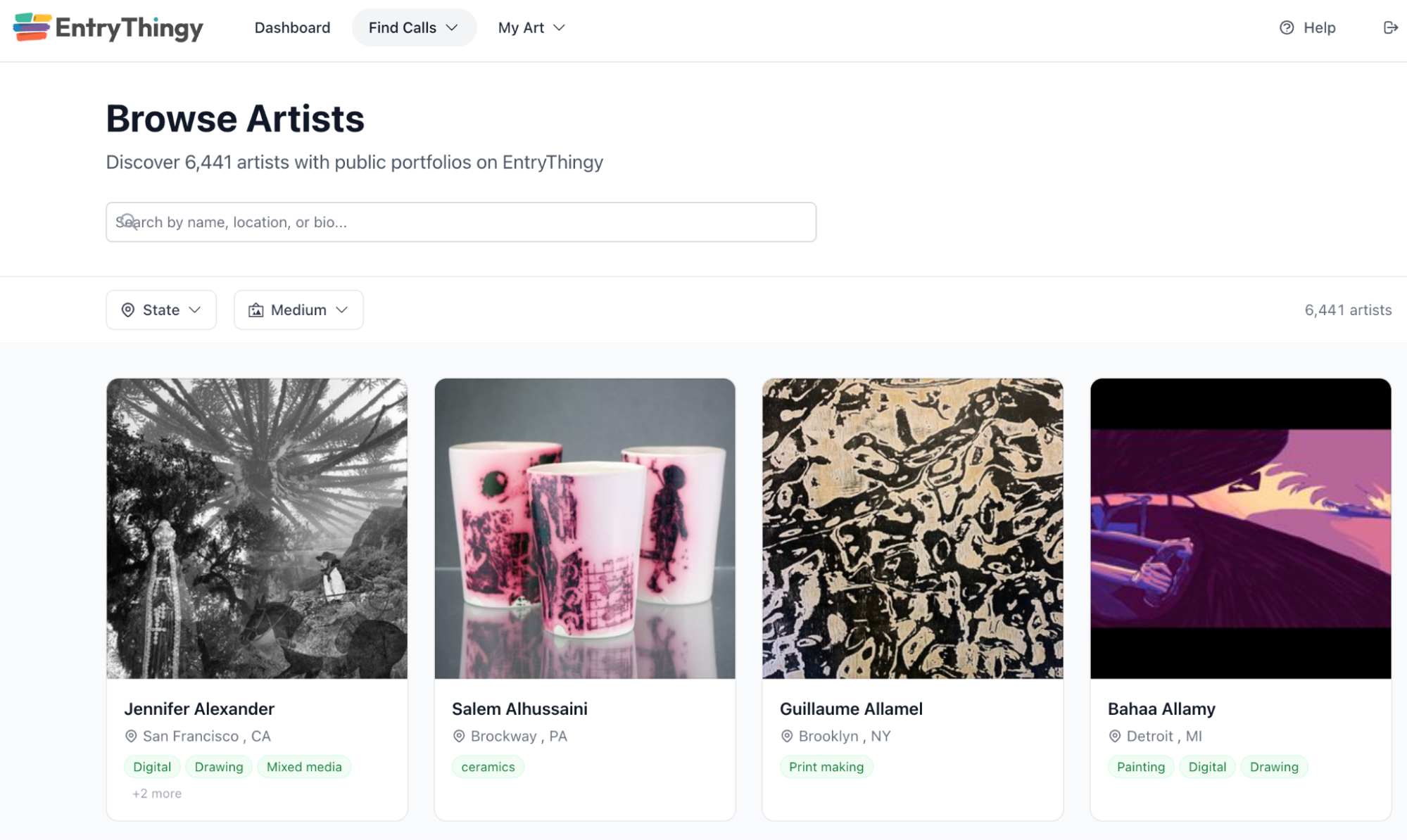
All statements in this article come from artists with public profiles on EntryThingy's Browse Artists directory, a searchable directory of over 6,440 artists with active portfolios on the platform.
The directory lets anyone search by name, location, bio, or medium to discover artists across every practice, and every profile is public, linking directly to the artist's statement, portfolio, and submitted work.
The 11 artists featured here were selected to represent a range of mediums and approaches, from jewelry to sculpture to collage. If you want to see more examples beyond this article, the Browse Artists directory is the best place to start.
Why this matters: in a juried show, a juror reviews your statement at the same time as your images, usually on the same screen, scrolling through dozens or hundreds of applications in one sitting.
They are not reading your statement after they have already decided whether they like the work. They are reading it while they decide.
A statement that gives them something specific to hold onto, right then, in that first pass, can shape how the images get read. A vague one gets skimmed and forgotten, and the work has to do all the work on its own.
For a step-by-step guide on writing your own, see our full guide on how to write an artist statement for juried shows.
1. The Place Artist Statement — Pastel and Painting
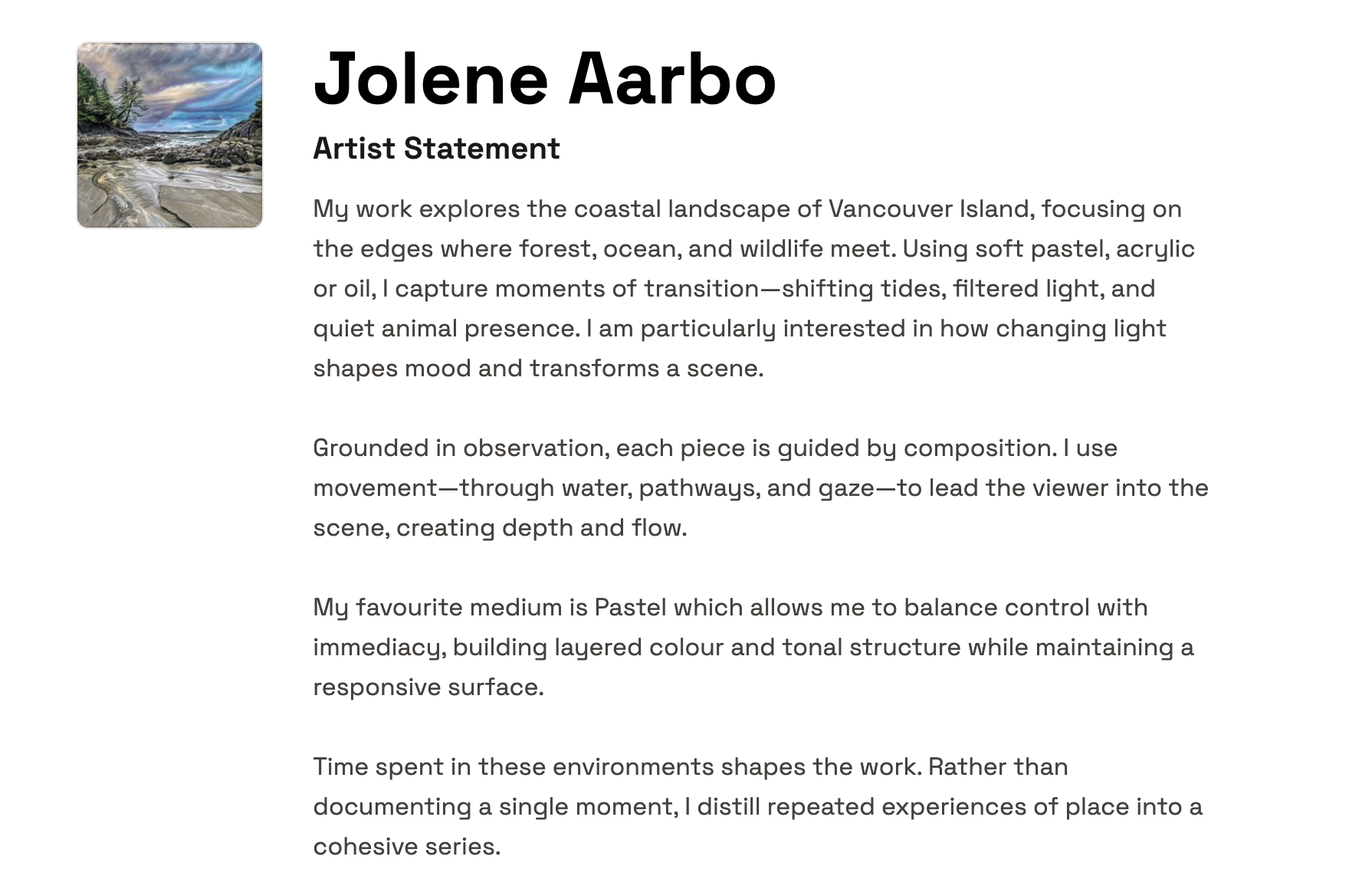
Jolene's statement opens with a specific place rather than an idea: the coastal landscape of Vancouver Island, and more precisely, the edges where forest, ocean, and wildlife meet. That choice does a lot of work in just one sentence.
What makes the statement hold together is a single line further down:
"My favourite medium is Pastel, which allows me to balance control with immediacy, building layered colour and tonal structure while maintaining a responsive surface."
Here she explains why it matters to the work, which is the harder and more useful thing to do.
A juror finishing this statement comes away with:
- The specific geography and environment she works from
- The medium and why she chose it
- The visual quality she is after (shifting tides, filtered light, quiet animal presence)
- That the work forms a cohesive series rather than standalone pieces
What you can learn from this: anchoring your statement in a specific place gives the juror an immediate visual context before they see a single image. It also signals that the work has a consistent subject, which helps when applying to themed exhibitions.
2. The Process Artist Statement — Enamel Jewelry
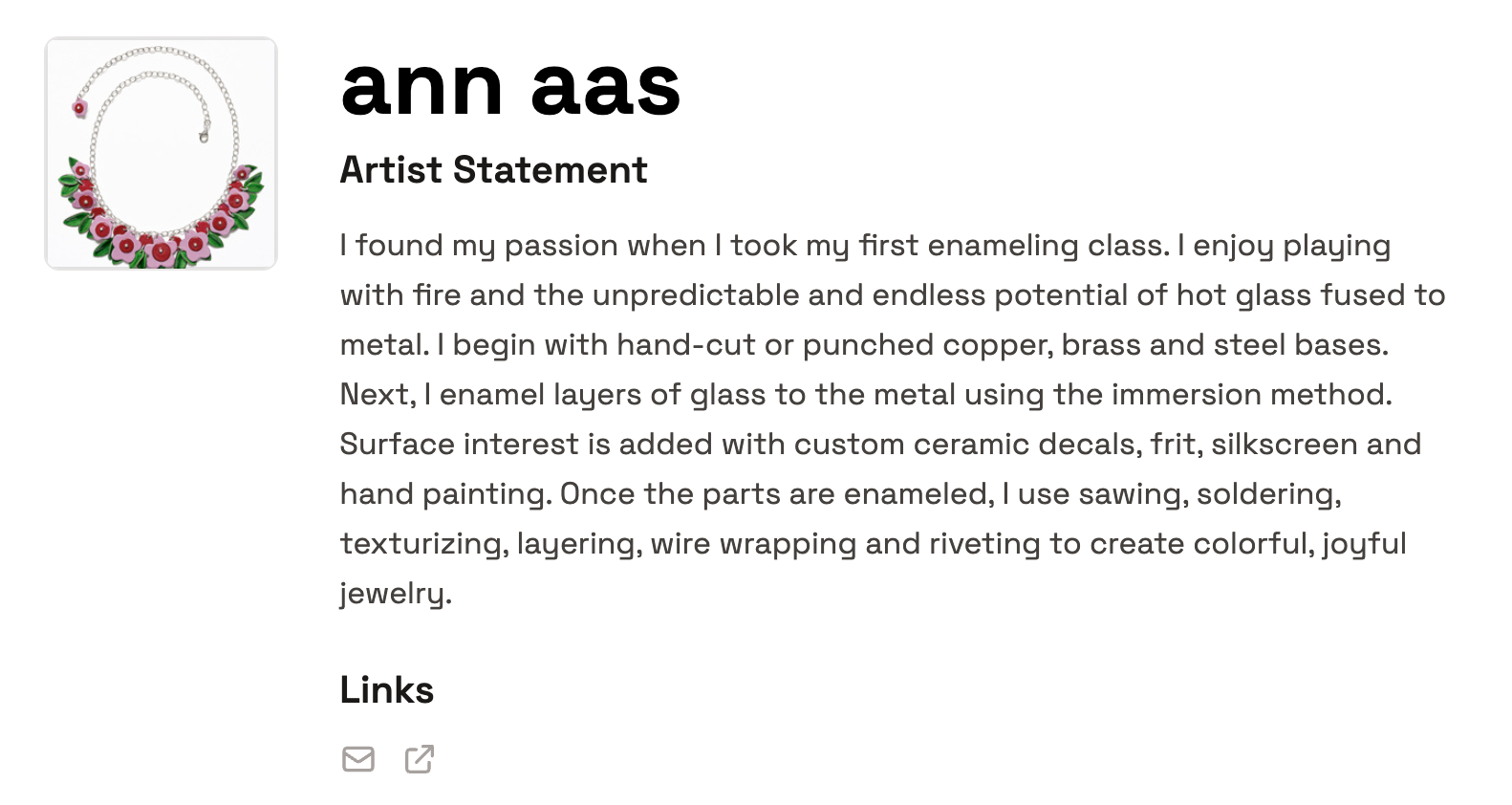
Ann's statement does something many artists avoid: it takes the reader through the process step by step.
She starts with the material (copper, brass, and steel bases), moves through enameling layers of glass using the immersion method, adds surface interest with ceramic decals, frit, and silkscreen, and finishes with sawing, soldering, texturizing, and riveting.
"I enjoy playing with fire and the unpredictable and endless potential of hot glass fused to metal."
That sentence does the emotional work while the rest of the statement does the technical work. Together they give the juror a complete picture of both what the pieces look like and why someone would spend years making them.
After reading this statement, a juror knows:
- The exact materials and techniques used
- The order of the making process
- The aesthetic result (colorful, joyful jewelry)
- That the unpredictability of the material is part of the appeal, not a limitation
What you can learn from this: for craft-based and materials-led practices, walking the reader through your process is not overly technical. It is the statement. The process is the meaning.
3. The Mission Artist Statement — Clay Sculpture
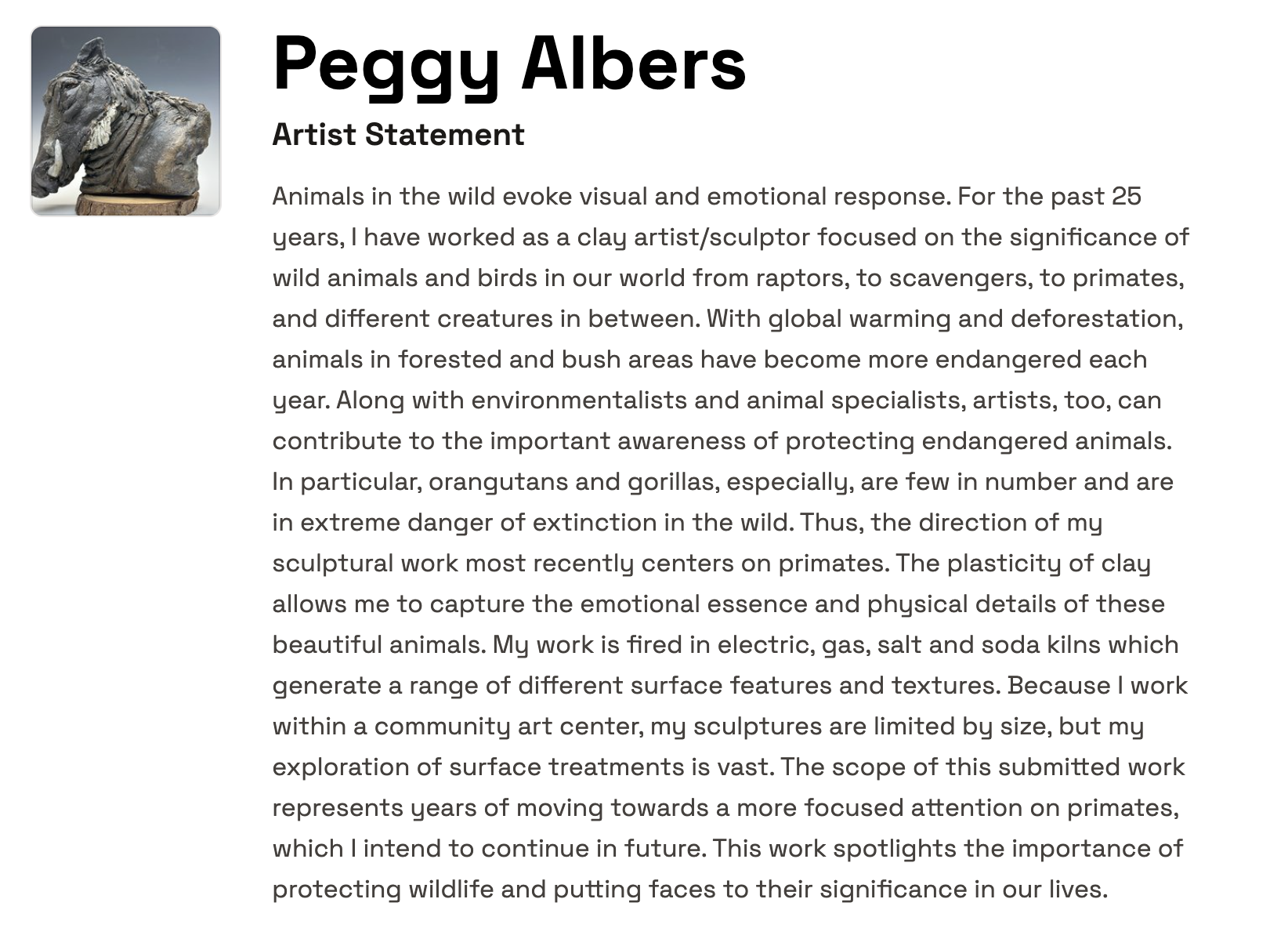
Peggy opens with a subject and a reason: wild animals and birds, and the urgency of protecting them. She names specific animals (orangutans, gorillas, raptors), names the threat (global warming and deforestation), and explains why clay is the right medium for this work:
"The plasticity of clay allows me to capture the emotional essence and physical details of these beautiful animals."
Her statement also does something useful for a juried show. It explains the scope of the submitted work directly.
She writes that her sculptural work "most recently centers on primates" and that the submitted pieces represent years of moving toward a more focused attention on that subject.
After reading this statement, a juror knows:
- The subject and the reason behind it
- The medium and why it serves the subject
- The specific direction of the current body of work
- The practical context (works within a community art center, limited in size but expansive in surface treatment)
What you can learn from this: connecting your subject to a larger reason, whether environmental, social, or personal, gives the juror a reason to care about the work before they see it. It also makes the statement memorable in a review of hundreds of submissions.
4. The Listening Artist Statement — Mixed Media
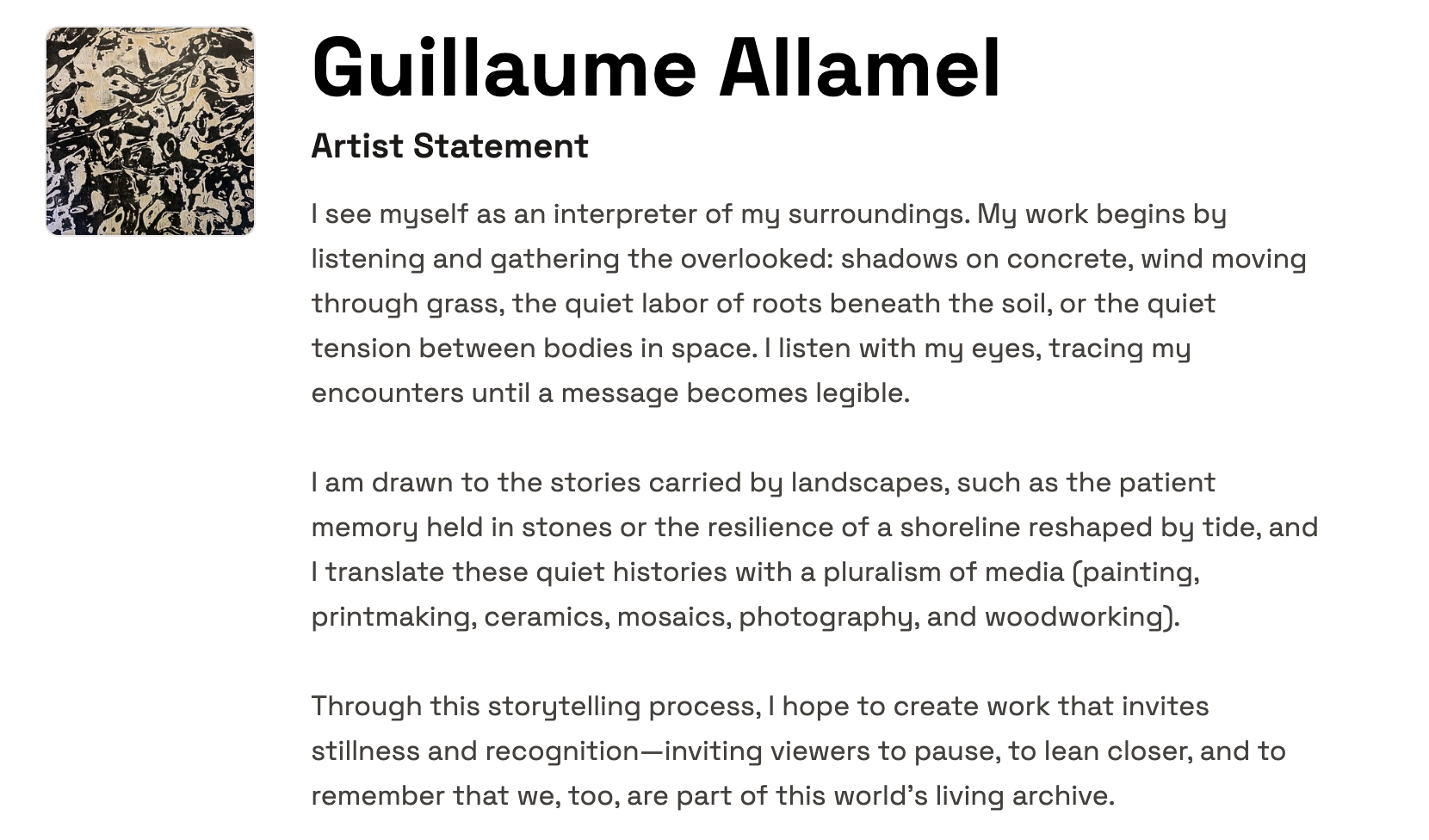
Guillaume's statement is one of the most distinctive in this collection. He opens not with a medium or a subject, but with a method of paying attention.
"I see myself as an interpreter of my surroundings. My work begins by listening and gathering the overlooked: shadows on concrete, wind moving through grass, the quiet labor of roots beneath the soil."
He uses three short paragraphs, which makes the statement easy to read and gives each idea room to land. The medium appears mid-statement rather than at the top: painting, printmaking, ceramics, mosaics, photography, and woodworking.
For a multi-media artist, listing them this way works as the subject and approach are already clear before the materials arrive.
A juror finishing this statement knows:
- The observational process that drives the work
- The specific kinds of subjects he is drawn to (overlooked, quiet, structural)
- The range of media and how they connect to the subject
- The intended effect on the viewer (stillness, recognition, a sense of belonging to the world)
What you can learn from this: if you work across multiple mediums, lead with your approach and subject rather than your materials list. The materials make more sense once the reader understands what you are paying attention to.
5. The Origin Artist Statement — Collage
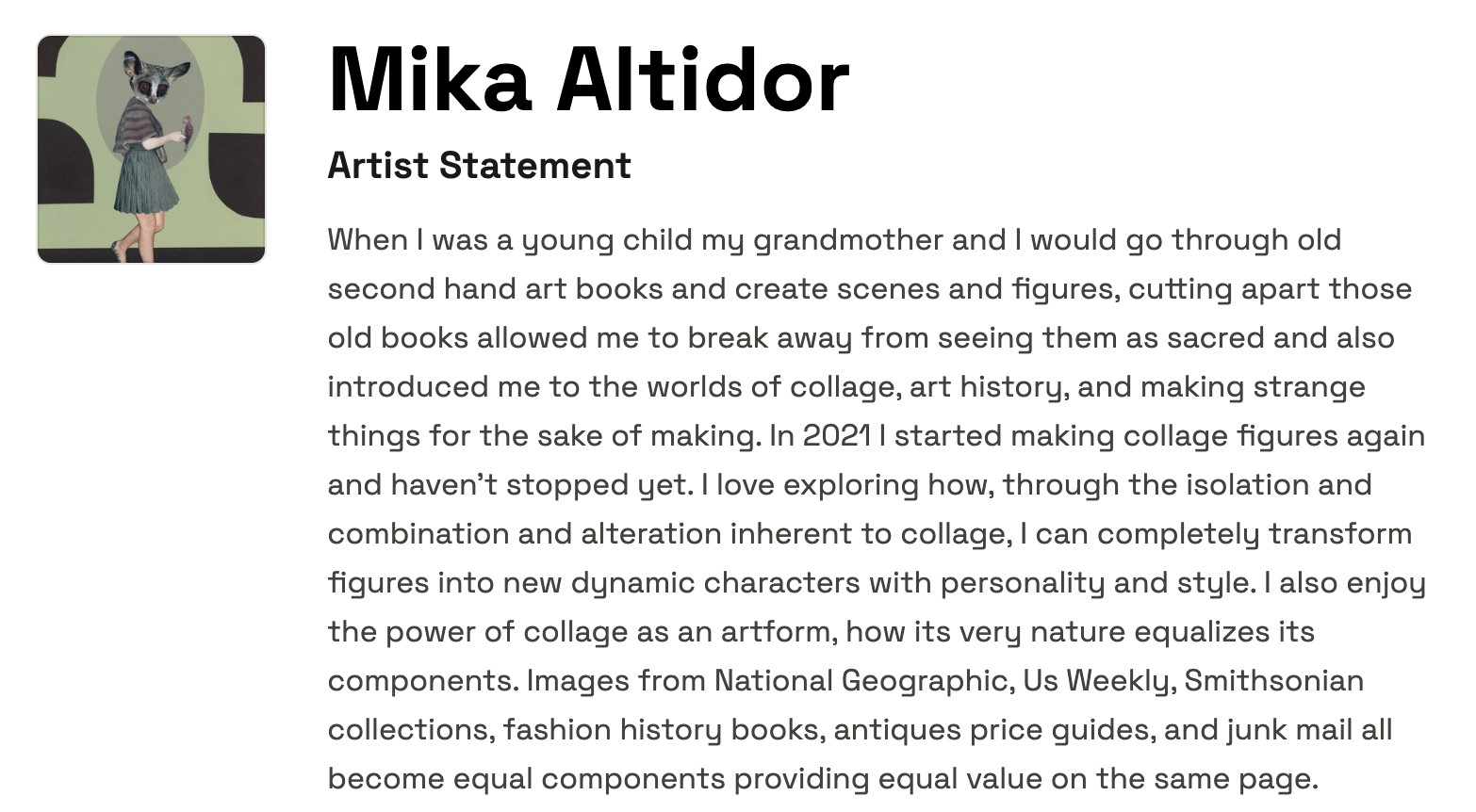
Mika opens with a childhood memory. Going through secondhand art books with her grandmother, cutting apart the pages, making scenes and figures.
It is a personal origin story that directly explains the medium, the philosophy behind it, and the specific materials she uses today. The story of how she started is also the story of why the work looks the way it does.
One detail makes the statement particularly strong:
"Images from National Geographic, Us Weekly, Smithsonian collections, fashion history books, antiques price guides, and junk mail all become equal components providing equal value on the same page."
That list explains the philosophy of the work in a single sentence.
Each paragraph adds something new. The origin, the process, the philosophy, the specific source materials, and finally the themes (fashion, women, history, humor, personality).
A juror finishing this statement knows:
- Where the practice came from and why it has continued
- The specific source materials she works with
- That she only uses existing images and never draws her own elements
- The themes and sensibility of the work
What you can learn from this: a personal origin story earns its place in a statement when it directly explains the work. If the story of how you started is also the story of why you make what you make, it belongs.
6. The Series Artist Statement — Clay Sculpture
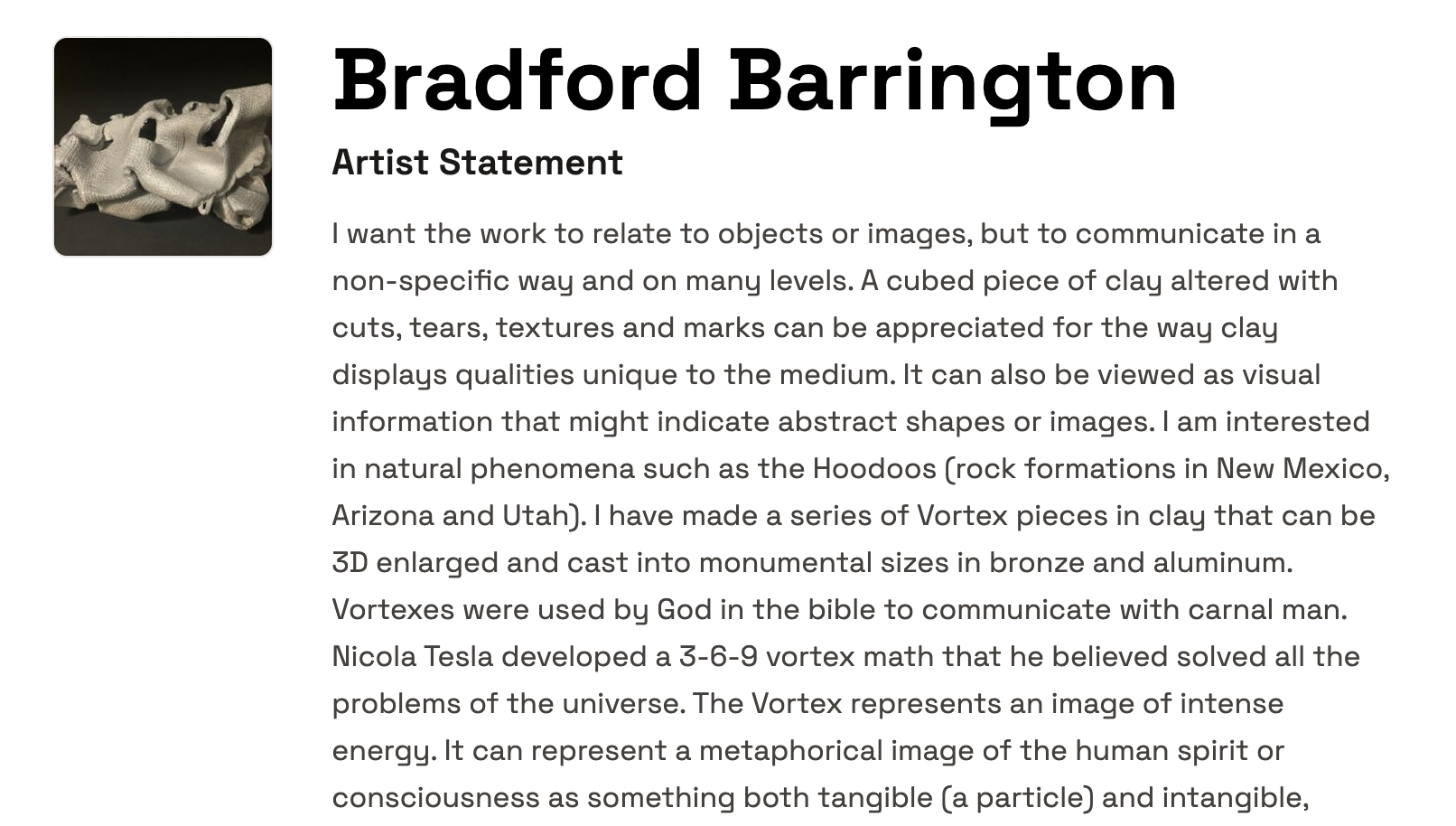
Bradford's statement names a specific series, "Meditation Through Time", a specific natural phenomenon that inspired it (Hoodoos, the rock formations of New Mexico, Arizona, and Utah), and a clear ambition for the work (to be 3D enlarged and cast into monumental sizes in bronze and aluminum).
That level of specificity is rare and gives the statement a strong sense of direction.
"I want the work to relate to objects or images, but to communicate in a non-specific way and on many levels." This opening sets up the central tension of the work: recognizable material, open meaning.
After reading this statement, a juror knows:
- The medium (clay, with surface treatments from multiple kiln types)
- The named series and its source material
- The philosophical intent behind the work
- The scale ambition of the practice
What you can learn from this: naming a specific series and its source material gives the juror an anchor. Even if the work is conceptually complex, one concrete reference point (the Hoodoos, the vortex form) makes the rest of the statement easier to follow.
7. The Tension Artist Statement — Mixed Media
Kyndel's statement opens with a strong conceptual frame:
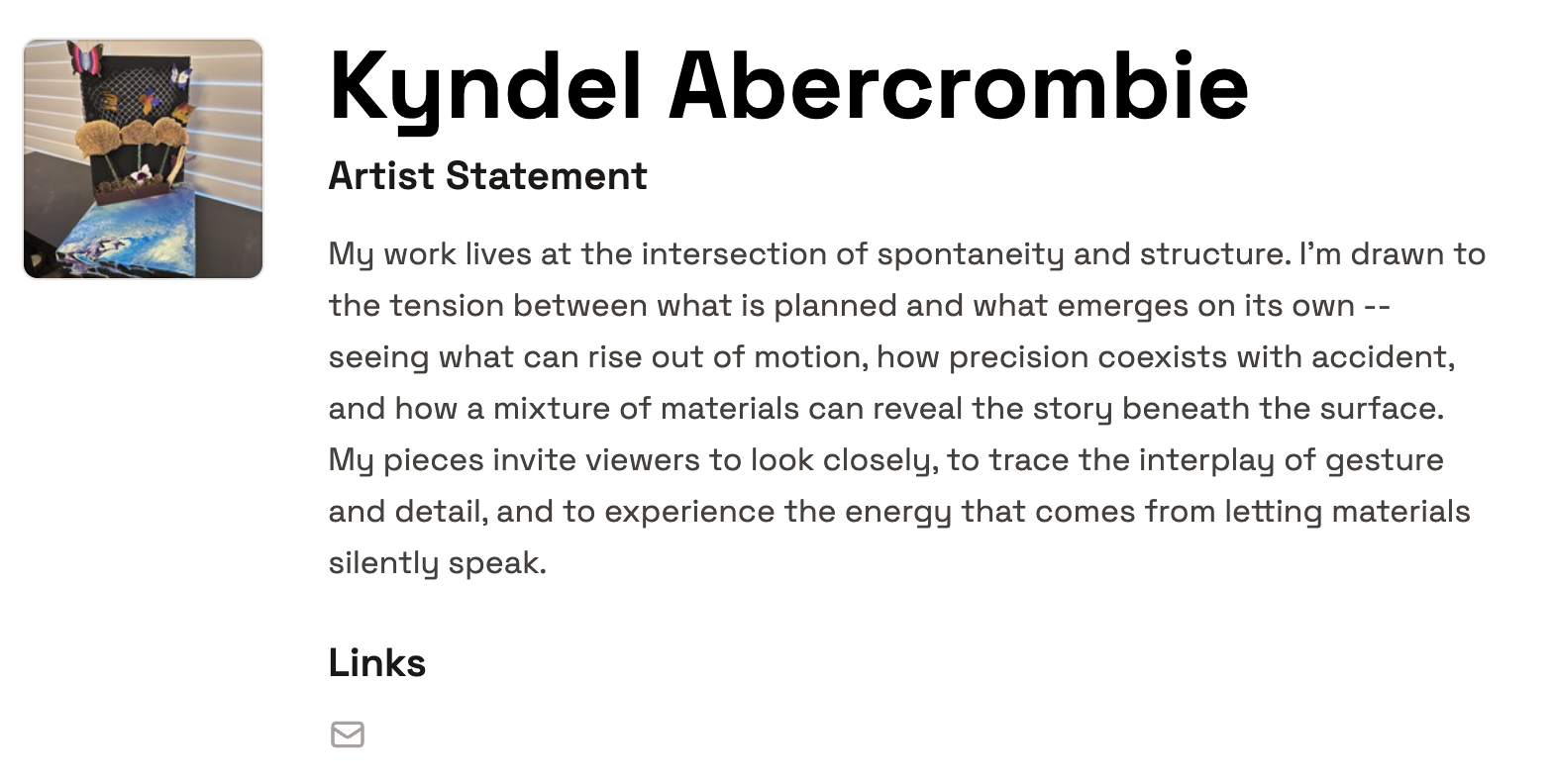
"My work lives at the intersection of spontaneity and structure."
She is clear about the tension that drives the work. What is planned versus what emerges, precision coexisting with accident, materials revealing the story beneath the surface.
The writing is confident and the concept is well-articulated. A juror reading this gets a strong sense of the artist's thinking.
After reading this statement, a juror knows:
- The central tension the work explores
- The process (motion, gesture, accident)
- The invitation to the viewer (look closely, trace the interplay)
- The energy the work is meant to hold
What could make it even stronger is naming the medium. The statement describes an approach but does not tell the juror what materials are being used.
What you can learn from this: looking at the portfolio, the work spans mixed media, acrylic pour painting, and sculptural assemblage. One sentence naming the primary materials would give the conceptual framing a physical anchor.
8. The Influences Artist Statement — Mixed Media
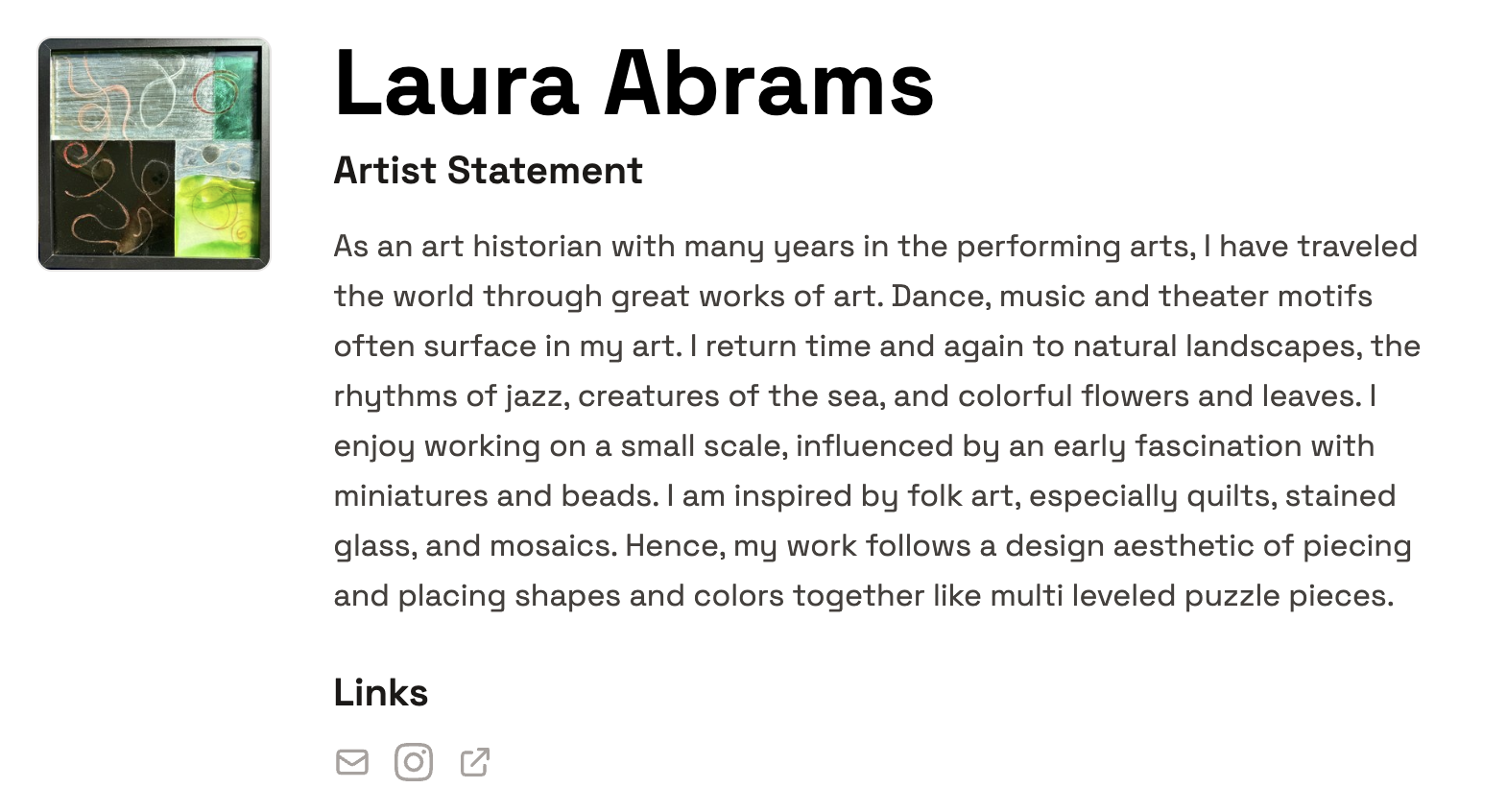
Laura's statement is built from a rich list of influences: dance, music, theater, natural landscapes, jazz, creatures of the sea, folk art, quilts, stained glass, mosaics, and the breadth of that list reflects a genuinely wide visual vocabulary.
As an art historian with a background in the performing arts, she has spent a long time looking, and the statement reflects that depth.
She writes that her work "follows a design aesthetic of piecing and placing shapes and colors together like multi leveled puzzle pieces."
That closing line is the first moment a juror can actually picture the work. It is specific, visual, and memorable and it would do more work at the beginning than at the end.
After reading this statement, a juror knows:
- The range of influences and their sources
- The preference for small scale work
- The design aesthetic (piecing, placing, layering)
- The art historical background that shapes the practice
What you can learn from this: the order matters more than the content here. The influences are interesting, but a juror scanning quickly needs to understand the visual result first. Moving the puzzle pieces line to the opening and letting the influences follow would give the same information in a more immediately useful sequence.
9. The Emotion Artist Statement — Abstract Painting
Ilene's statement is written in third person, which is a valid and often-requested format for juried show applications.
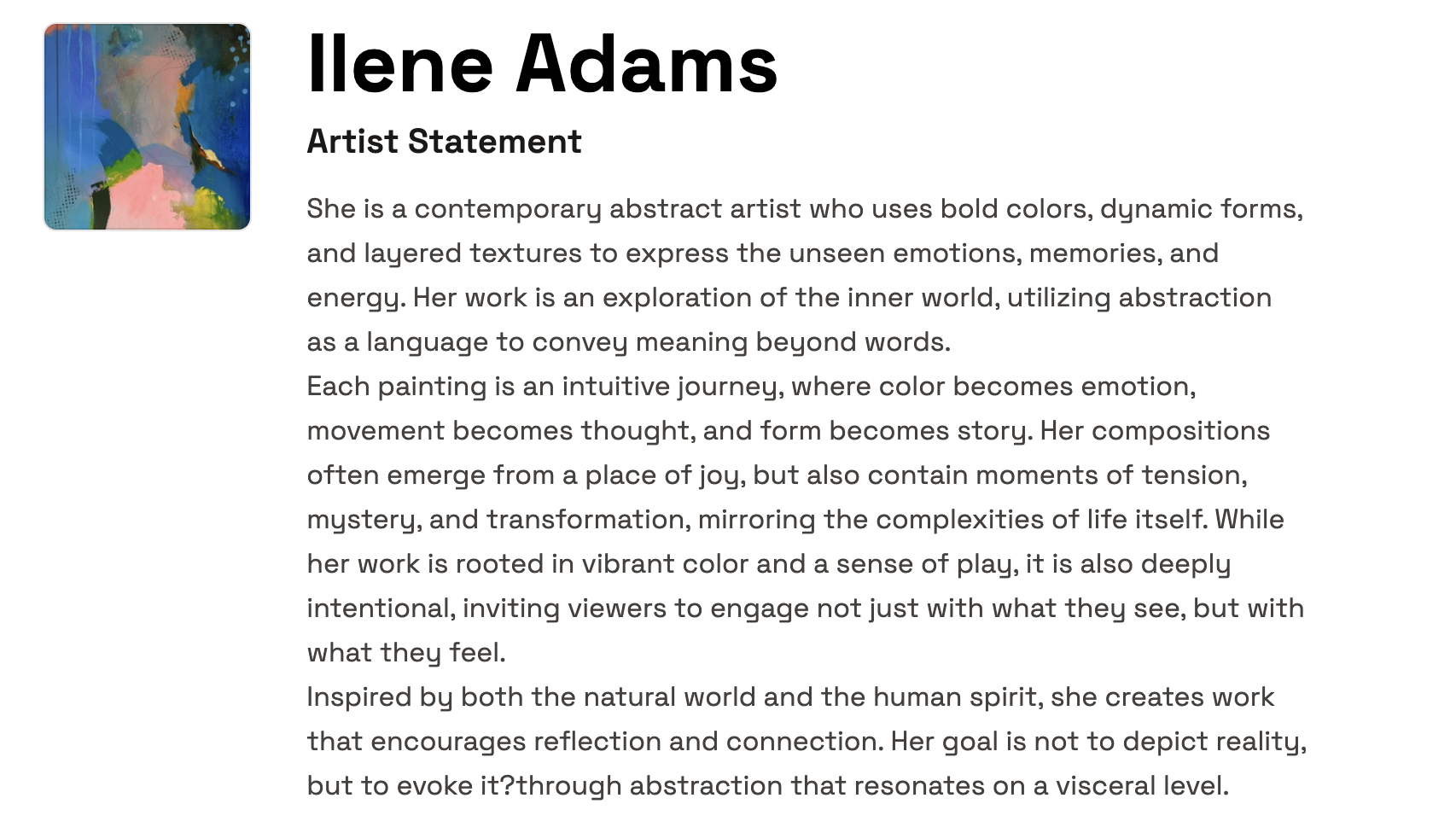
She describes bold colors, dynamic forms, and layered textures, and frames the work around emotion, memory, and energy. The statement is well-written and gives the reader a clear sense of the tone and intention behind the work.
One line in particular lands:
"Each painting is an intuitive journey, where color becomes emotion, movement becomes thought, and form becomes story."
It is the kind of sentence that stays with a reader after the application is closed, which is exactly what you want in a competitive review.
After reading this statement, a juror knows:
- The medium (abstract painting)
- The visual vocabulary (bold color, dynamic forms, layered texture)
- The emotional territory of the work (joy, tension, mystery, transformation)
- The intent (to evoke rather than depict)
What you can learn from this: one specific detail about the physical work itself, such as scale, material, or a recurring visual element, would ground the emotional language. Abstract statements benefit from at least one concrete anchor that connects the feeling to the object.
10. The Story Statement — Drawing and Painting
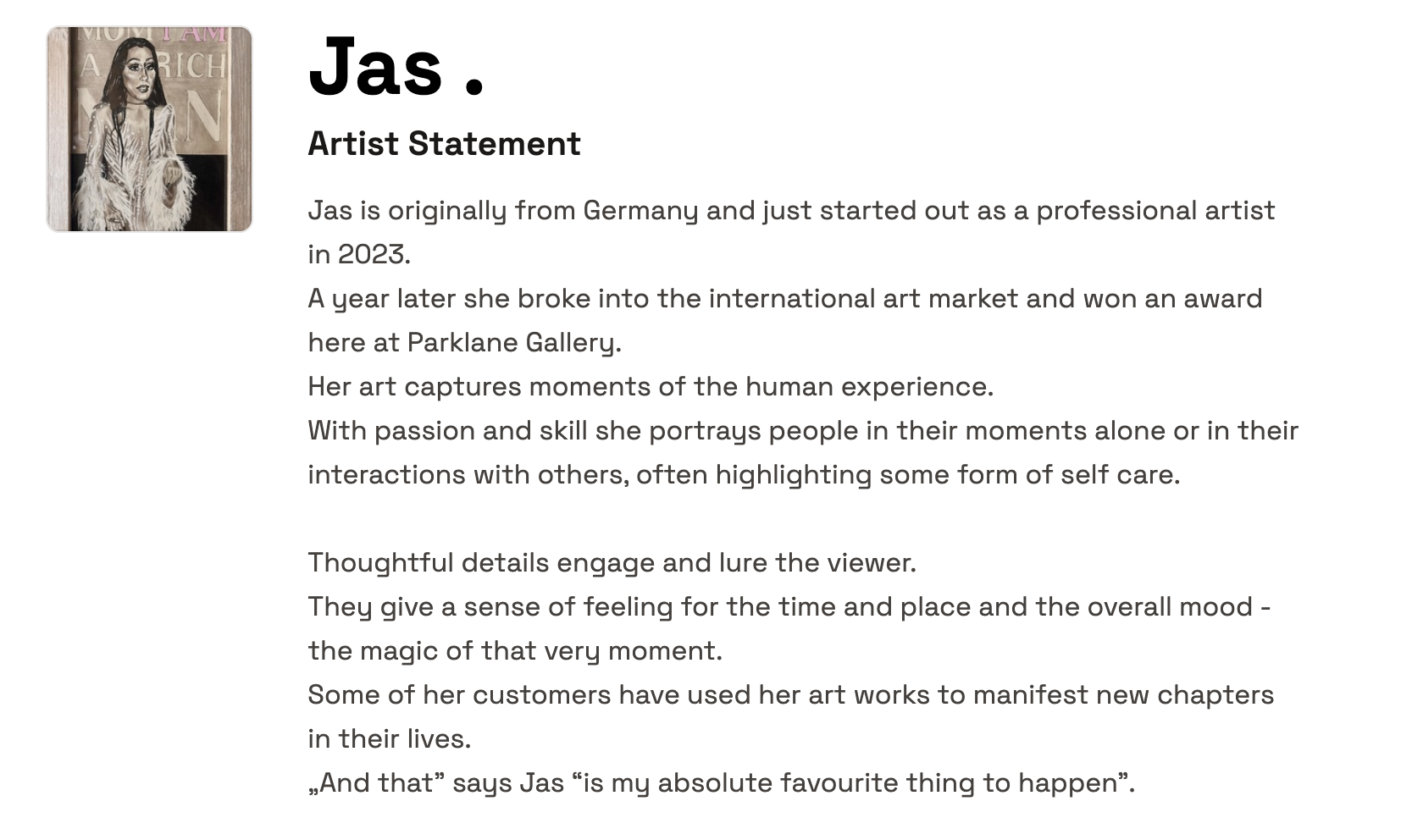
Jas's statement gives the reader a clear emotional subject: people in moments of solitude or connection, with self-care at the center. A juror reading this understands the emotional territory of the work before seeing a single image.
"With passion and skill she portrays people in their moments alone or in their interactions with others, often highlighting some form of self care."
That focus on quiet interpersonal moments gives the statement a warm, specific quality.
After reading this statement, a juror knows:
- The subject: figures in moments of self-care and human connection
- The tone: intimate and observational
- That viewers have personally connected with the work in meaningful ways
What you can learn from this: naming the medium upfront (drawing and painting) and describing the visual quality of the figures. A juror who knows the work is figurative drawing and painting, and has a sense of how the figures are rendered, has a fuller picture before the images load.
11. The Clarity Statement — Jewelry
Suzanne's statement is one of the shortest in this collection, and that brevity is a choice worth noticing.
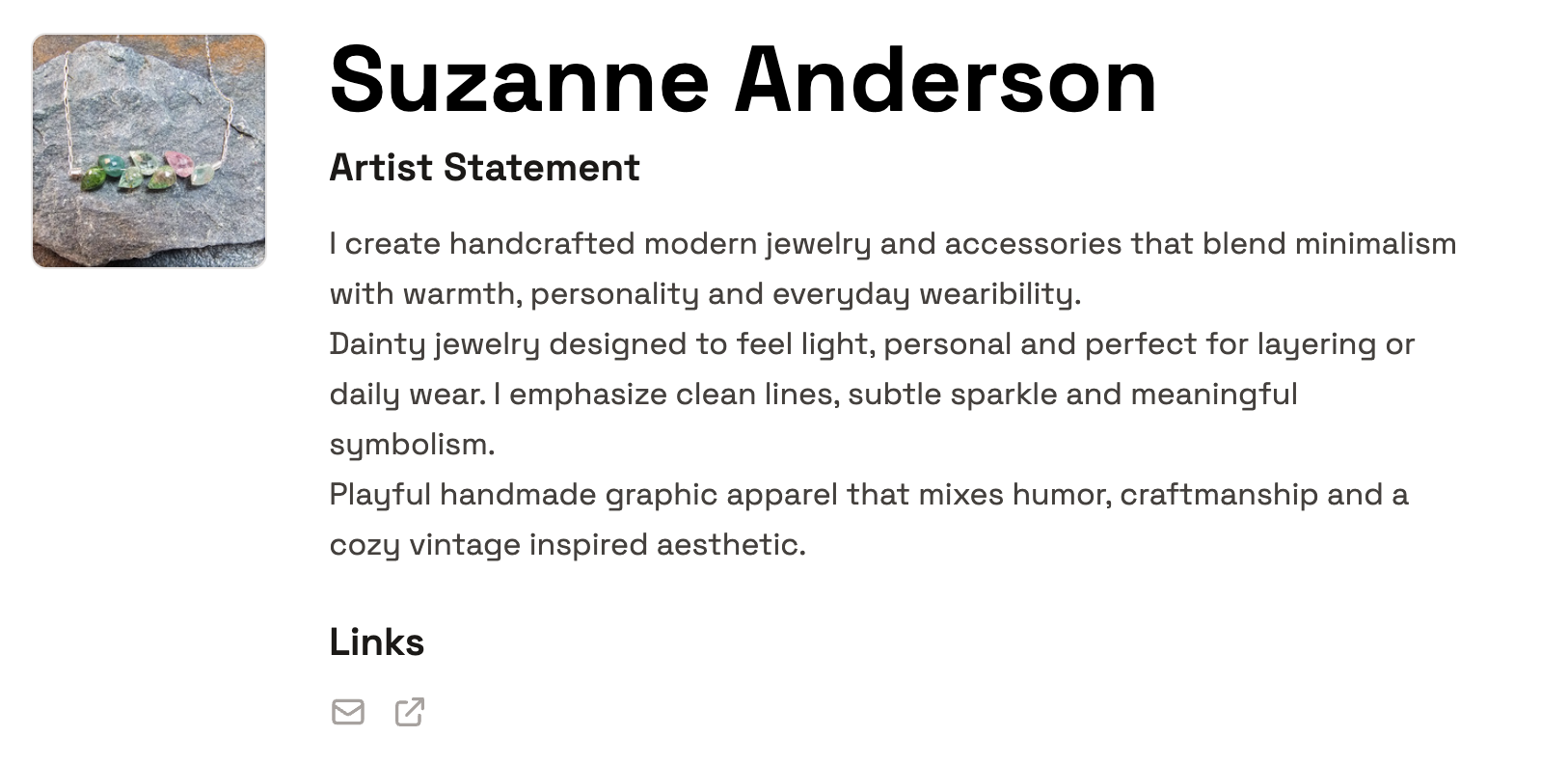
Three sentences, each describing a different aspect of the work: the overall aesthetic (minimalism with warmth), the jewelry specifically (dainty, light, layered, symbolic), and the apparel line (playful, handmade, vintage-inspired).
The opening does its job clearly:
"I create handcrafted modern jewelry and accessories that blend minimalism with warmth, personality and everyday wearibility."
A juror reading it immediately knows what kind of work to expect. There is no ambiguity about the practice or the aesthetic, which is a harder thing to achieve than it looks.
After reading this statement, a juror knows:
- The medium (handcrafted jewelry and accessories)
- The aesthetic (minimalist, warm, wearable)
- The design values (clean lines, subtle sparkle, meaningful symbolism)
- That the practice spans both jewelry and apparel
One sentence about the making process or the materials would add depth. Short statements work well when every sentence carries weight.
What you can learn from this: adding the materials or the technique Suzanne uses would give the statement a stronger craft identity without losing the clarity she already has.
What These Examples Have in Common
Across 11 artists and 11 different approaches, the statements that give a juror the most to work with share a few things:
- They name the medium, even briefly
- They give the work a specific subject, place, series, or tension to anchor around
- They explain something about the process or material choice that connects to the meaning
- They use their own voice rather than generic art language
None of them are perfect. Several could be stronger with one additional sentence. But all of them give a juror something concrete to hold onto before the images load, and that is the job.
If you are ready to write or rewrite your own, our guide on how to write an artist statement for juried shows covers structure, length, common mistakes, and a template you can adapt.
And if you want to browse more real examples from artists across every medium, the EntryThingy Browse Artists directory has over 6,440 public profiles you can search by medium, location, and name.
FAQs About Artist Statements
How long should an artist statement be for a juried show?
Most calls ask for 150 to 300 words. Some are shorter. Always check the call page for a specific word limit and follow it exactly. The examples in this article range from three sentences to several paragraphs. Length is less important than clarity.
Should an artist statement be written in first or third person?
Most juried show applications ask for third person. Some ask for first. Check the call requirements before you write. Several examples in this article use third person and several use first. Both can work well.
What should an artist statement include?
You should include the medium, the subject or theme of the work, and something about the process or intent. The best statements also connect the process to the meaning, explain what connects the submitted pieces, and give the juror a specific visual anchor before they see the images.
What is the difference between an artist statement and an artist bio?
An artist statement explains the work. An artist bio explains the artist's background, career, and practice. They are different documents with different jobs. For help with the bio, see our artist bio examples and artist resume examples.
Where can I find more real artist statement examples?
The EntryThingy Browse Artists directory has over 6,440 artists with public profiles, searchable by medium, location, and name. Every profile includes the artist's statement and portfolio images.