
6 Artist Portfolio Mistakes That Get You Rejected (And How to Fix Them)
Most artists who get rejected from a juried show assume the work wasn't good enough. That assumption is usually incomplete.
Across hundreds of juried shows on EntryThingy, the same six mistakes come up every time.
Here's what we found, and how to fix each one before your next submission.
Key Mistakes
Not connecting your pieces is the most common reason strong work gets passed over, and it rarely comes down to quality.
Poor lighting, wrong file format, and low resolution are the most fixable rejection causes, and the most overlooked.
Submitting work you made five or six years ago tells a juror you are no longer active at that level.
Every piece you are unsure about is actively working against your strongest ones.
A statement that could describe any artist in any medium gives a juror nothing to evaluate before the images load.
How We Put This List Together
We process thousands of submissions through EntryThingy across hundreds of juried shows. We hear directly from galleries about what makes applications fall short, and from artists trying to understand why strong work keeps getting passed over.
We also analyzed 7 real artist portfolios from working artists across painting, sculpture, jewelry, collage, digital art, and mixed media, to see what worked and what didn't.
Mistake 1: Your Portfolio Feels Disconnected
If a juror cannot immediately understand what your practice is about from your submission, the application gets passed over. Cohesion means the work feels like it came from the same artist, even if the subjects vary.
This is the first mistake galleries mention, and it rarely comes down to quality. Jurors are not evaluating three or five pieces in isolation. They are trying to understand your practice as a whole. A submission that jumps between unrelated styles, mediums, and subjects gives a juror nothing to hold onto, and applications without a clear through line get passed over.
One artist in the painting community put it:
"When it goes in a gallery or show it has to flow with the other work and the customer base. They're curating a whole show, not just picking individual pieces."
From what gallery directors tell us, the most common cohesion problems they see are:
- Submitting work that has already been sold. If a piece is not available, keep it out of the application.
- Missing piece information. No price, no description, or incomplete details make the application feel unfinished.
- Submitting work that does not match the show's theme. Entering a watercolor show with oil paintings signals you did not read the call carefully. This is one of the reasons your artwork gets rejected.
- Leaving out a resume or artist statement. Both are part of a complete portfolio submission.
- Too many clashing styles with no consistent thread. Variety reads as inconsistency when nothing connects the pieces.
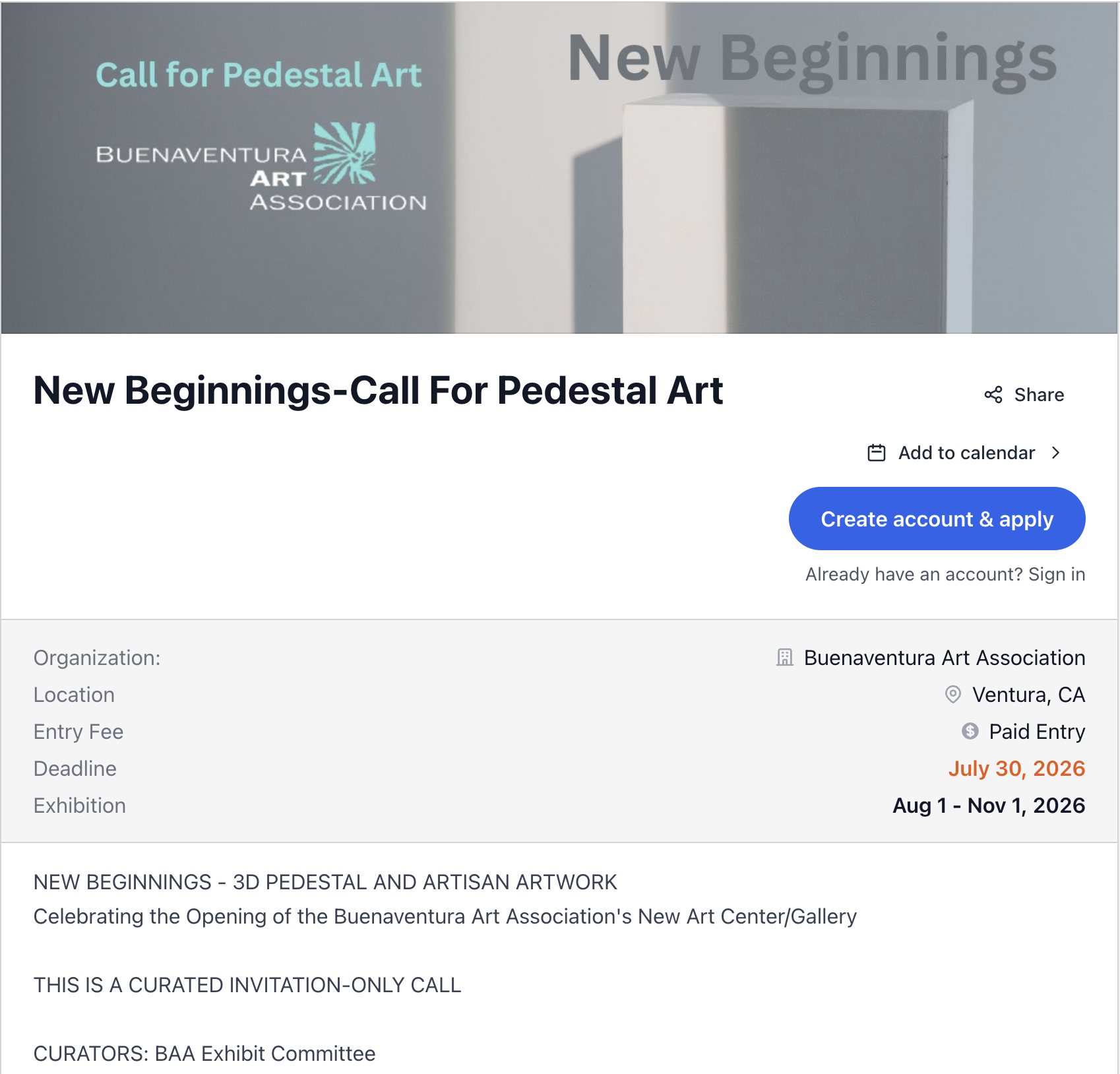
Every call on EntryThingy shows you the medium, location, entry fee, deadline, and exhibition dates before you apply, so you can check the fit before committing time to an application.
Our guide on how to build an artist portfolio for calls covers what jurors actually look for.
Mistake 2: You Are Showing Too Much Work
More pieces are not a stronger submission. Jurors review hundreds of applications. They are not going to spend twenty minutes with yours. Submit forty pieces and they will skim. Submit eight strong ones and they will actually look.
Every piece that is not your best work is working against you. Most calls give you a limit for a reason, so stay within it and use every slot with intention. If the call asks for three pieces, do not treat that as a floor. Three exceptional pieces will almost always outperform five mixed ones.
Most juried shows score each artwork individually. Two strong pieces will outperform two strong and three weak ones every time because the weaker pieces drag your average score down. Your weakest piece is what a juror remembers.
Mistake 3: Your Photos Are Making Strong Work Look Weak
In digital jury review, a juror evaluates your submission on a screen before they see your work in person. Poor lighting, distracting backgrounds, and low resolution are the most common reasons submissions get rejected.
A juror has no access to scale, texture, or the physical presence of the piece. What they have is a JPEG. Make sure yours does not have any of these:
- Uneven or harsh lighting that flattens the work
- Visible surroundings: studio walls, easels, table edges, outlets
- Cropping that cuts off edges or leaves too much dead space
- Low resolution that looks soft or blurry at full screen
- Color casts that shift the actual tones of the piece
Most calls specify JPEG format with a minimum of 1920px on the longest side. If you are shooting on a phone, make sure you are exporting correctly. Phones default to HEIC (a file format most submission platforms do not accept), so always convert to JPEG before uploading. Never upscale a small image to meet dimension requirements. It adds pixels but not detail, and it shows.
Pro tip: Use natural light from a window or a neutral white light source positioned on either side of your artwork to eliminate glare and get even coverage. If your work is framed behind glass, remove the glass before photographing.
If you want to skip the manual resizing entirely, EntryThingy's Pixel Prep tool handles it for you.
Built directly into your portfolio under My Art → Portfolio → Pixel Prep, it resizes your image to 1920px on the longest side and compresses it to a 1-2MB JPEG, which meets the requirements for most art calls.
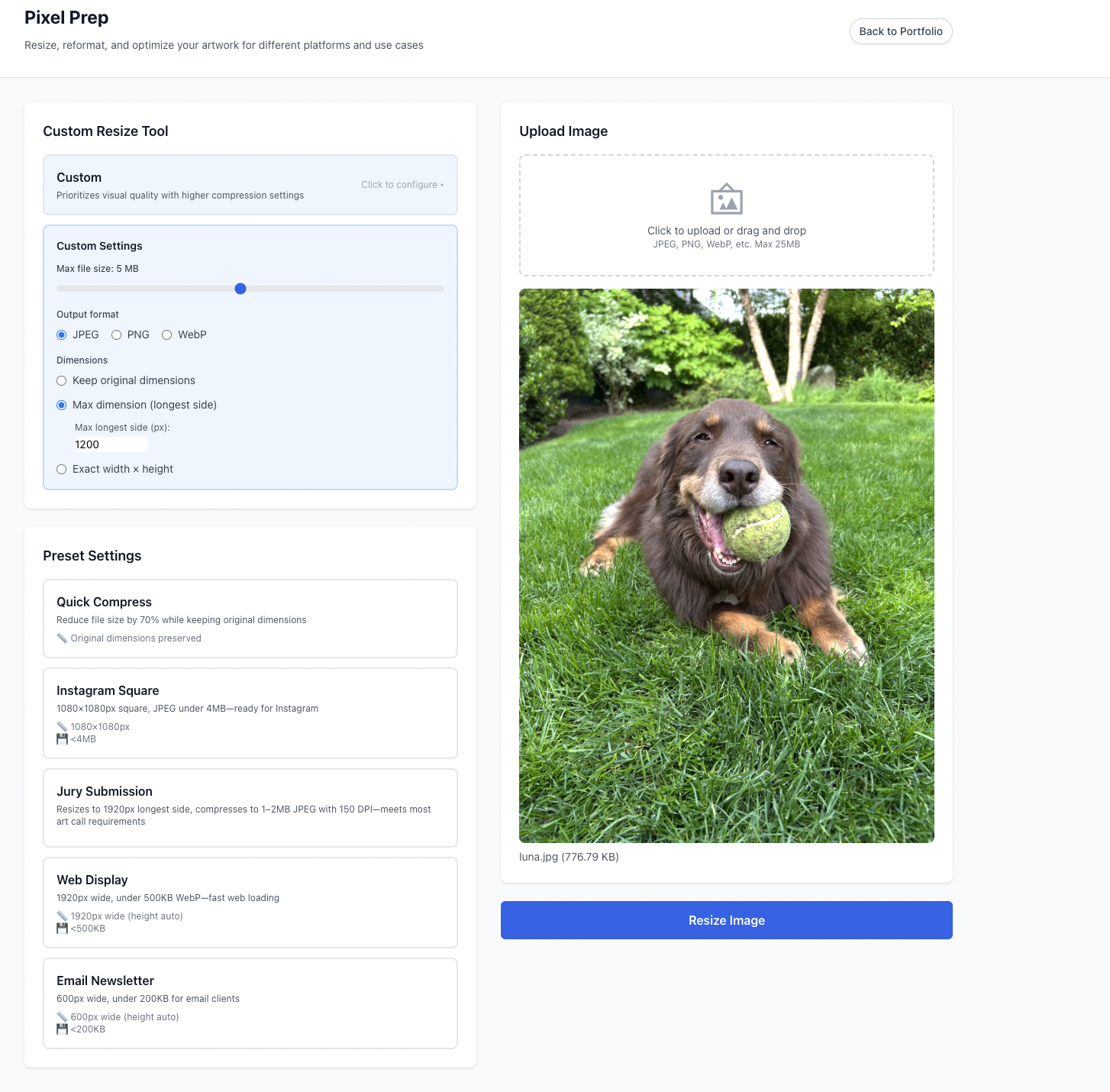
You can also use the custom settings panel to set your own dimensions and file size when a call has specific requirements that don't match a preset.
Mistake 4: Your Work Is Outdated
Submitting old work shows you are no longer active. Lead with recent work and show that you are producing right now.
If your most recent piece is from five or six years ago, a juror has no way of knowing whether that reflects where you are now. They will assume it does. Active artists submit recent work. It shows you are still practicing, still developing your style.
One artist described it after a rejection:
"They said the work was strong but felt dated. I hadn't updated my portfolio in three years. That was the whole problem."
A good rule: if you would not make that piece today, it probably should not be in your submission.
Mistake 5: Your Statement Describes Art-Making in General, Not Your Work Specifically
An artist statement has one job. To help the juror connect your work to your intent. If it could apply to any artist, it is not doing that job.
Most statement problems are not about bad writing. Jurors skip statements that are too vague, too long, or too general to say anything specific. A juror reviewing 200 submissions will not slow down for a 600-word philosophical essay. They need to understand your work in 30 seconds.
You should avoid:
- Language that could apply to any artist ("My paintings capture fleeting moments of beauty in everyday life")
- Academic jargon that distances the reader from the work
- Going beyond 200 words when the call does not ask for more
Read your statement back and ask yourself: does this help someone understand these specific pieces, or does it describe art-making in general?
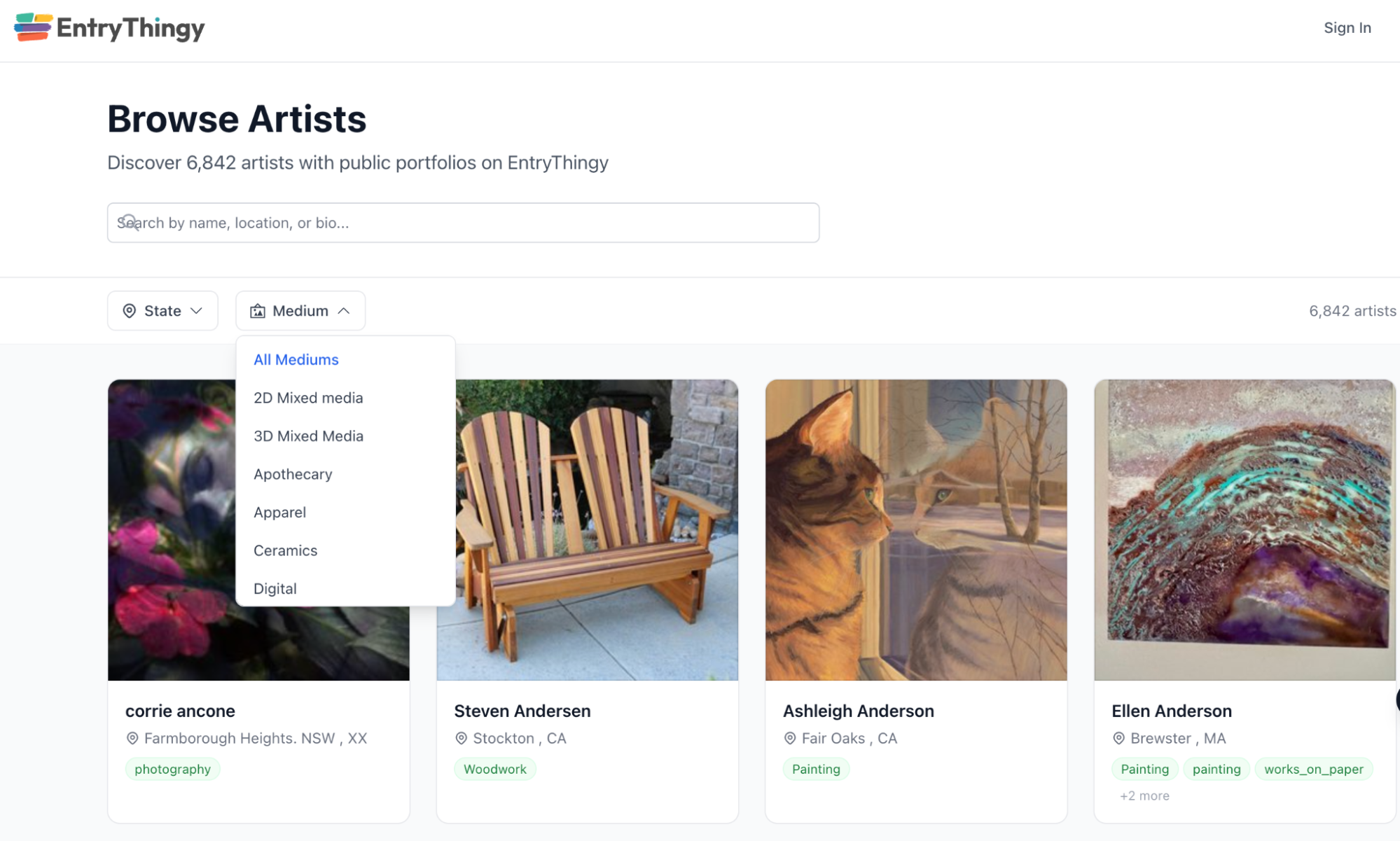
For real examples, browse over 6,842 public artist profiles on EntryThingy's artist directory. Each profile includes the artist's statement, bio, and work, so you can see how working artists write about their practice in their own words.
Our guide on artist bio examples is also a good starting point if you are building yours from scratch, and our artist statement examples show 11 real statements from working artists if you want to see what strong ones look like.
Mistake 6: You Are Applying to Calls That Are Not a Good Fit
Applying to every open call regardless of fit wastes entry fees, drains your energy, and produces rejections that teach you nothing. You should research before you apply.
Artists who build strong exhibition records are selective. They read the call carefully, check whether their work genuinely fits, and treat each submission as worth preparing properly.
Our acceptance rates data shows that first-time submitters are accepted at 58.3%. Artists with 4 to 10 submissions reach 78.5%. Artists who keep applying get better at choosing the right calls and preparing stronger submissions. That is what compounds over time.
One artist put it simply:
"I used to apply to everything. Now I apply to maybe a third of what I used to and my acceptance rate is three times higher. The difference is just actually reading the call before I apply."
Ready to find calls that fit your work? Browse verified art calls on EntryThingy filtered by medium, cost, location (state, city), and deadline before you apply.
Browse Art Calls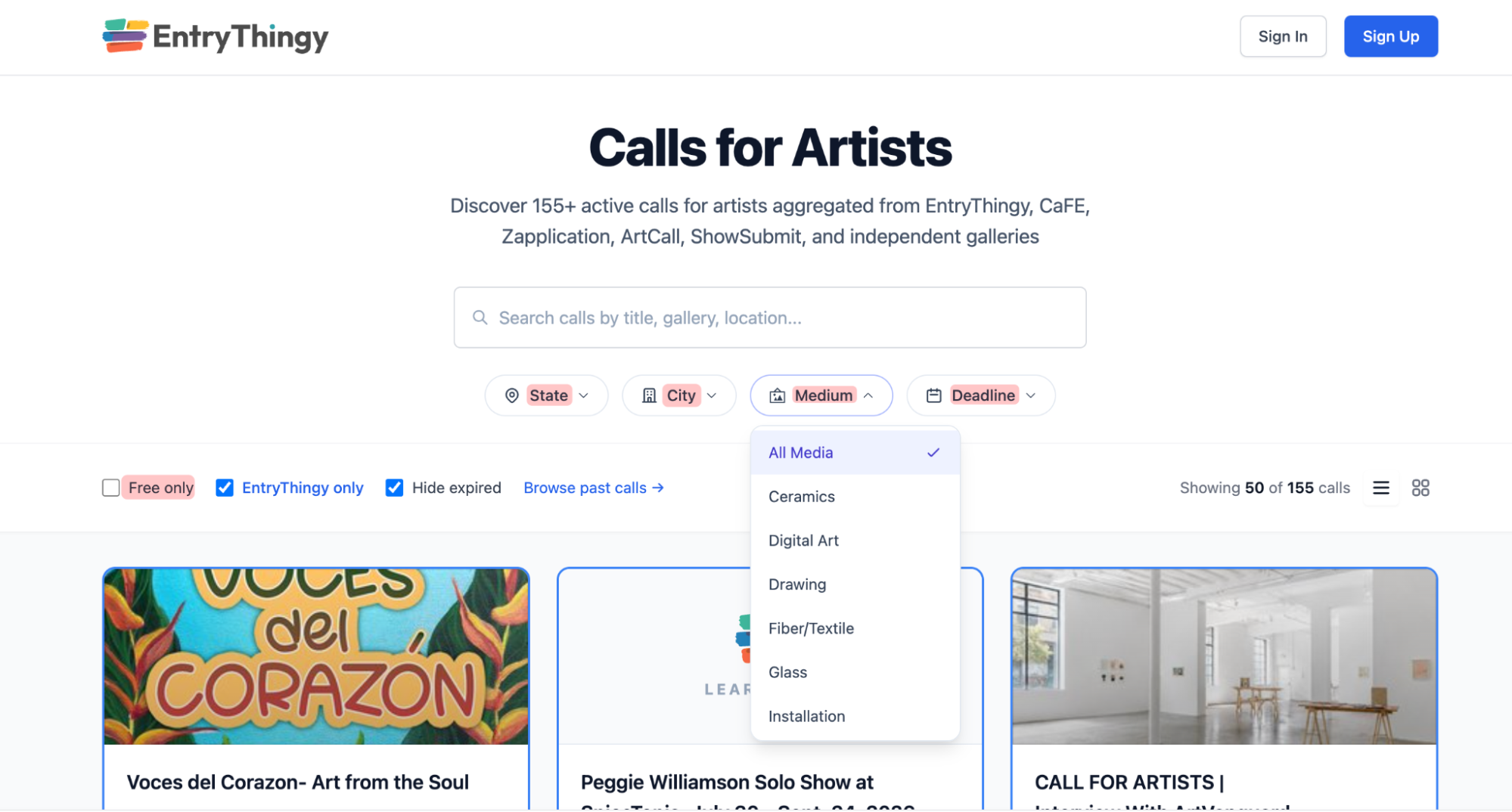
FAQs
Why do art portfolios get rejected even when the work is strong?
Acceptance decisions depend on fit, cohesion, and presentation, not just quality. Strong work gets rejected from shows that were not the right context for it, or when the submission had preventable problems like weak images, missing information, or work that did not match the call's theme.
How many pieces should I include in a portfolio submission?
Most calls specify a limit, typically between three and ten pieces. Stay within it and use every slot with intention. A submission of eight strong, well-matched pieces will almost always outperform one of twenty mixed ones.
How do I know if my work fits a specific call?
Read the call description carefully, look at past shows the gallery has run, and ask honestly whether your work matches what they are looking for. On EntryThingy, every call lists its theme, medium requirements, eligibility, and juror information upfront so you can evaluate fit before committing to an application.
What should I include in my artist portfolio for a juried show?
At minimum: your strongest recent work, complete piece information (title, medium, dimensions, price), an artist statement, and a resume or CV. Missing any of these is one of the most common reasons applications feel incomplete to jurors.
Where can I find calls that are worth applying to?
Browse verified art calls on EntryThingy filtered by medium, location, and deadline before you apply.